Generalise the Fundamental Theorem of Calculus: the integral of a derivative over a region equals the value of the function on the boundary.
divergence theorem (Gauss)
Think of
The total flux crossing the closed boundary equals the sum of all sources minus sinks inside. If water flows out of a lake (the surface integral) and there’s a non-zero net flow, there must be a spring or leak inside.
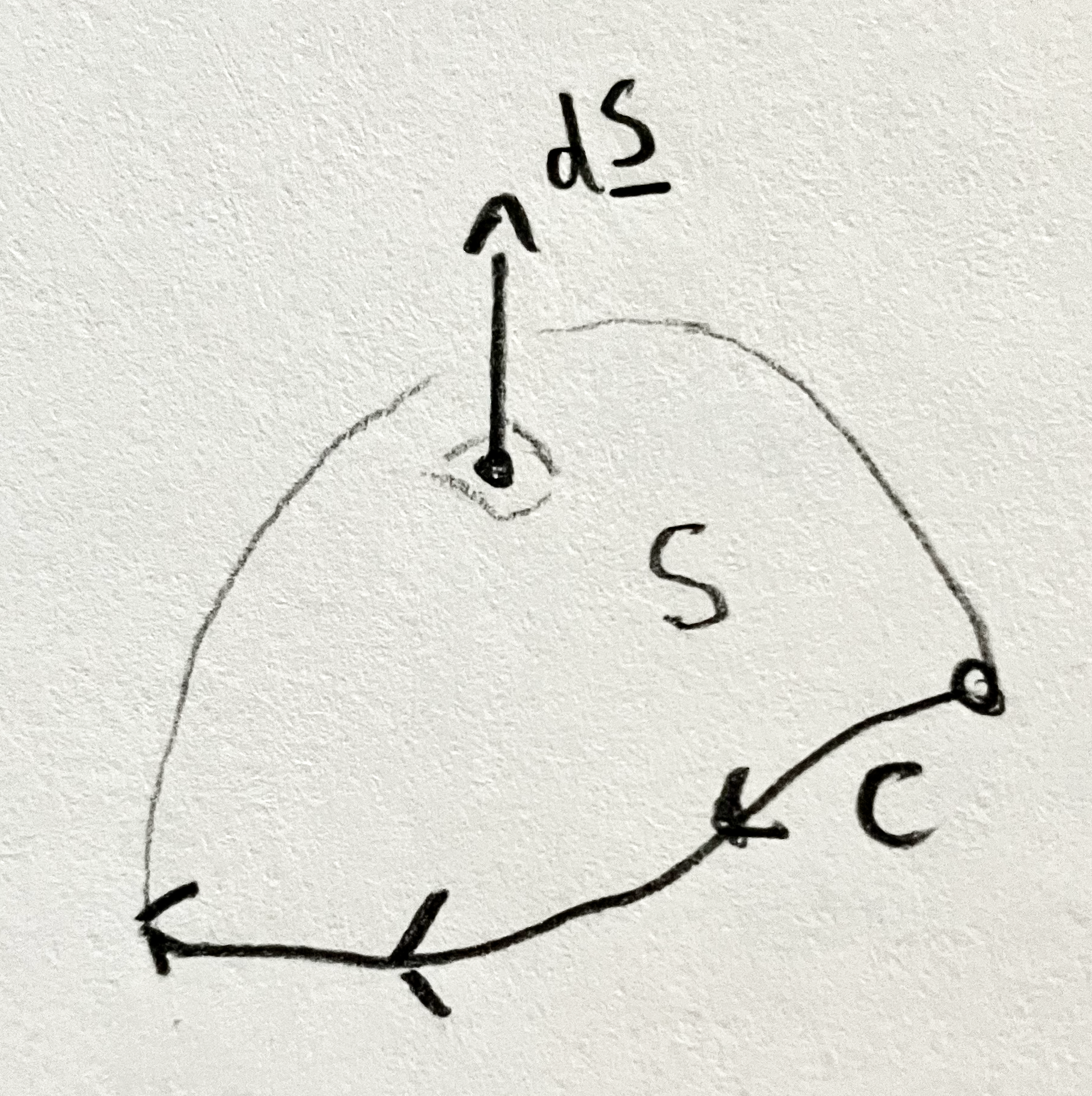
Stokes’ theorem
The circulation of
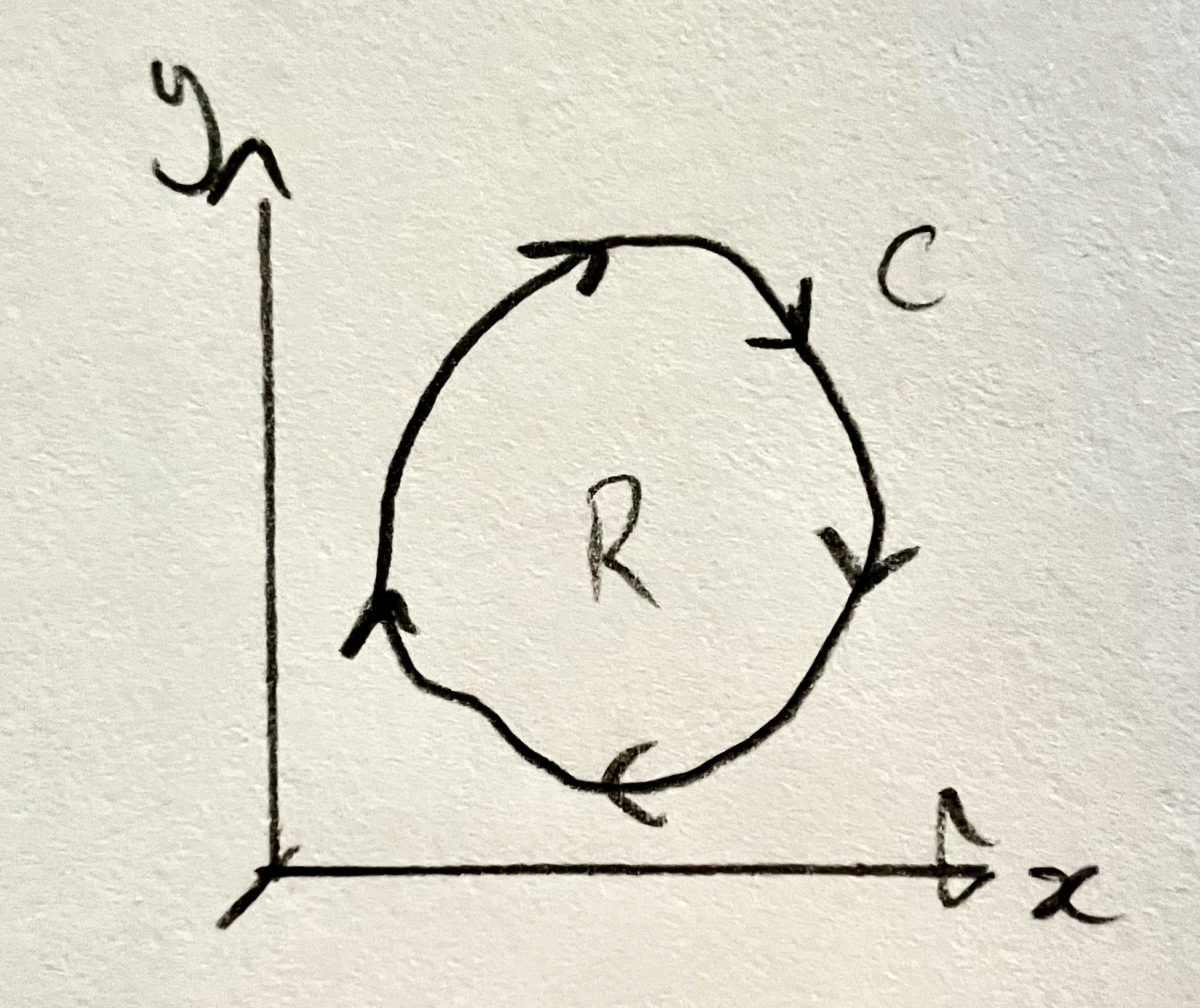
Green’s theorem (Stokes in 2D)
Specialise Stokes to a flat surface in the xy-plane:
The 2D curl
Jacobian decomposition
The Jacobian
J = jax.jacfwd(F)(x)                                 # 3×3 Jacobian
div = jnp.trace(J)                                   # ∂F_x/∂x + ∂F_y/∂y + ∂F_z/∂z
curl = jnp.array([J[2,1]-J[1,2], J[0,2]-J[2,0], J[1,0]-J[0,1]])
curl_2d = J[1,0] - J[0,1]                            # ∂Q/∂x - ∂P/∂y